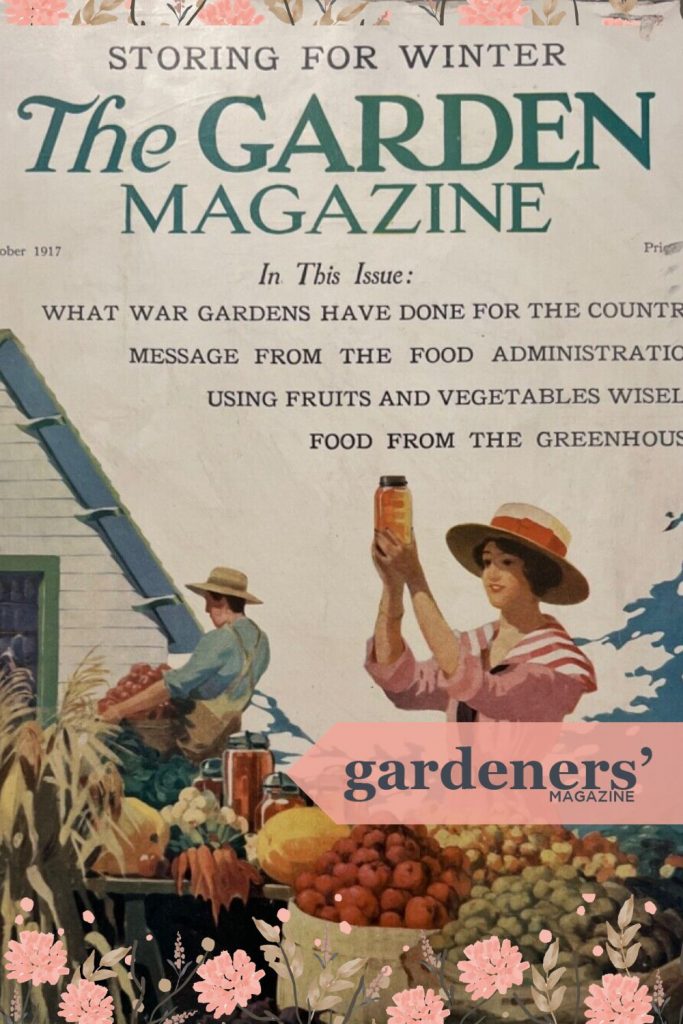
|

Plan of Garden 50-ft. square
|
May 1917 |
|
Front Cover / Inside Front |
|
Inside Back / Back Cover |
|
|
|
211 |
Spring Time is Lilac Time AD |
212
213
214 |
More Crops from Your Garden ADs |
|
215 |
Manure, Catalog ADs |
|
216 |
Nursery, Bulb ADs |
|
217 |
Irrigation, Greenhouse ADs |
|
218 |
Nurseries, Portable Houses ADs |
|
219 |
Table of Contents |
|
220 |
The President to the People
(Wilson's plea for gardens) |
|
221 |
Among our Garden Neighbors |
|
222 |
Papaya, Opal Anchusa, Cotton,
Japanese Knotweed |
|
223 |
Gordonia, Building a Better Home,
Letters |
|
224 |
The Month's Reminder |
|
225 |
Summer Flower-Roots for Present
Planting - Gladiolus |
226
227 |
Dahlia |
228
229 |
New Deutzias Better than Old |
|
230 |
The Rockery Idea in Edgings |
|
231 |
Home Vegetable Gardens A
Patriotic Duty |
232
233 |
How the Modern Lilac Came to Be |
|
234 |
Victor Lemoine, Plant Hybridist |
235
236 |
The Evolution of My Garden |
|
237 |
The New Race of Hardy Astilbes |
238
239 |
Prepare in May for Winter Flowers |
240
242 |
Novelties in Summer Flower-roots
and Bulbs |
|
243 |
Flower Ads |
|
244 |
The Fruit Garden -
Crown Grafting |
|
245 |
Nursery ADs |
246
247
248 |
How to Pot A Plant |
|
247 |
Gladiolus, Evergreens, Trellis ADs |
|
249 |
Lawn Mower, Nurseries ADs |
|
250 |
Insurance by Protection |
|
251 |
Flower ADs |
|
252 |
Watermelon Stem End Rot |
|
253 |
Lawn Mower, Flowers ADs |
|
254 |
The Indigoferas for Late Flower |
|
255 |
Shrubs, Rudyard Kipling, Humas ADs |
256
258
260 |
Coming Events Club & Society News |
|
257 |
Book ADs |
|
259 |
Greenhouse, Birdhouse, Portable
Houses, Flag Poles ADs |
|
261 |
Pottery, Greenhouse, Stoves, Wire
Cloth ADs |
|
262 |
Companions for Larkspurs |
|
263 |
War Air Generator, Listerine,
Stanley, Birdhouses ADs |
|
264 |
Chicken Chowder, Fence, Portable
Poultry Runways, Oregon & California Railroad Co. Land Grants for Sale
(2,300,000 acres)ADs |
|
Home Vegetable Gardens A Patriotic Duty
ANNA M.
BURKE - Massachusetts
MAKING THE MOST OF LIMITED SPACE—VEGETABLES IN CONTINUOUS SUPPLY—USING
THE GROUND TWICE OVER—ECONOMICAL LABOR METHODS
OUR kitchen garden is small—a scant
fifty feet each way—yet from it are gathered practically all the vegetables
needed for a family of three from the middle of May to the first of
November, with a good surplus sterilized in glass jars for winter use.
Yet, however great the yield, I always consider that the best crop
gathered from the garden is experience. The year that I do not discover some
new variety, an improved method of growing, or some better arrangement or
combination of vegetables, leaves me with a barren feeling, conscious of
having taken a step backward rather than forward in garden culture. But let
us take things specifically in detail.
Corn. Although the catalogues set the middle of May as the
time to plant corn, we plant half a row about May 1st, or even earlier if
the season is warm. The dwarf yellow varieties (Golden Bantam and its
successors), are quite hardy, and if the weather is good, early planting
gives a fine start, whereas the loss of a few seed is immaterial if
conditions prove unfavorable. This year I shall try the experiment of
setting a row of 10-inch boards along each side of the trench and laying
sheets of glass on top, to form a sort of frame. This simple device proved
very successful with lettuce last fall, keeping it growing up to
Thanksgiving in the open garden. I shall try the same device with string
beans, and later with cucumbers [and we hope tell
The Garden Magazine of the
results—Ed.].
String Beans. After experiencing the surfeit of string beans
that follows a generous planting of this vegetable, I have adopted the plan
of sowing a very small quantity at intervals of two weeks. Much seed is
wasted by planting thickly, because beans need to be six inches apart in the
row to do well, and eight or ten inches apart is better still. By selecting
only the plumpest and firmest seed, I can set them the required distance
apart, thus wasting no see and sparing myself the trouble of thinning
thereafter. Our garden is comparatively free from cut-worms, thanks to
frequent cultivation and the encouragement of bird neighbors, but where this
pest abounds the seed must be sown more thickly to allow for his
depredations.
Lima Beans. Having tried without marked success the pole
varieties and the large-seeded bush limas, we have found that the small
Sieva bean (Henderson's Bush Lima) can be depended upon to produce a good
crop whether the summer be cold or hot, wet or dry. Every seed seems to
germinate (therefore may be sown thinly, requiring less seed), and the yield
of small, but well filled, pods continues until frost.
Tomatoes. We have always trained our tomatoes on 6-foot
stakes, because they take up less room, but after several years'
experimenting I have come to the conclusion that the pinching off of all but
one stem is a needless sacrifice, unless one desires to grow a few specimen
fruits. Two and even three or four stalks may be allowed to develop, with no
appreciable loss in size or quality of the tomatoes, and the yield is much
greater. About the first of September pinch off the tip of each branch,
allowing the strength of the plant to go into developing the fruit already
set, rather than producing more blossoms which could not be expected to
mature before frost. Contrary to the advice of some authorities, we find the
tomato does best in a fairly rich soil.
Chinese Cabbage. Although we usually fight shy of novelties,
we tried the Chinese cabbage and found it a most attractive vegetable,
producing firm, elongated heads of crisp, white leaves, which may be used as
a salad or cooked as a vegetable. It is delicious either way. Care must be
taken, however, not to plant the seed too early, or the heat of midsummer
will cause it to send up blossom stalks instead of forming heads. If planted
about the first of July and kept growing steadily, firm white heads weighing
two or three pounds, will be produced in September. Query: Might it not also
be started in a frame in March and matured before hot weather, as in the
case of cauliflower? |
Witloof Chicory. If you relish the bitter tang
of this salad (sometimes called French Endive), for which restaurants and
markets ask such good prices, you may be interested to know that it can be
forced all winter in your own cellar. An article by Frances K. Porter in the
April, 1916,
GARDEN MAGAZINE prompted me to
try this vegetable, and my almost perfect success makes me anxious to add a
word in its favor. Seed was sown in drills eighteen inches apart about the
middle of May, thinned to stand six inches apart in the row, and kept
cultivated all summer, with an occasional dose of nitrate of soda. The
larger the roots, the better they will force. About the first of November
the parsnip-like roots were dug and piled in a sheltered corner next the
house, covering them with coarse litter. A dozen roots were forced at a
time, setting them upright in a deep box (an orange box with tow
compartments is ideal) and filling in around them with good garden loam,
mixed with fine bone meal. The box should be deep enough so that the soil
may cover the tops to a depth of three or four inches, and this top soil
should be sifted. The box was placed beside the heater in the cellar, given
a good watering with lukewarm water, and covered with papers to keep out the
light. In a few days white shoots began to show and in two weeks we had
thick cones of tightly folded leaves, crisp and perfectly blanched. We cut
them an inch or two below the surface of the soil, and the plants continued
to send up more shoots. By bringing in roots at intervals of two weeks,
salad may be enjoyed all winter.
Peas. We used to be quite satisfied if this delectable
vegetable graced our Fourth of July dinner table, but after observing an old
Italian, who tilled a vacant lot nearby, pick well grown peas by the middle
of June, I set out to learn his secret. It was really very simple—merely
early planting in the sunniest spot available. Now we do not wait until
the ground has dried out, but just as soon as it can be worked (about April
1st to 9th, latitude of Boston), the first sowing of peas is made in a
2-inch trench. If possible, the trench is opened the day before, which gives
the sun a chance to warm and dry the soil. Only an inch of covering is put
on the seed, the rest being filled in as the little plants grow. These early
planted peas have a larger and better root system than those planted later,
with consequent increase in quality and quantity of pods. Another
"experience"" By planting medium and late varieties at one time in the
latter part of April we get a longer yielding season than if early varieties
are planted at intervals in succession. The early varieties all strive to
make up for lost time the moment they get into the ground, and rush to
maturity in quantities that glut the market, leaving a dearth to follow. The
late varieties are planted in a 6-inch trench, which gives their roots
better foraging ground through the heat of midsummer. Indeed, this season I
am planting the late peas in a 10- or 12-inch trench (like Sweet Peas),
filling in the trench gradually, of course. This should help them to weather
quite a severe dry spell.
Potatoes. Most books on gardening state that the potato has no place
in a small garden—although after the exorbitant prices commanded by this
plebeian vegetable during the past winter, one expects to see even the front
lawns turned into potato patches! But even under normal conditions I think
it pays to plant a row or two of early potatoes, and to plant them early.
My neighbors used to scoff until I "showed" them by having potatoes for the
table by July Fourth, when theirs were scarcely in blossom. If the ground is
at all fit, early potatoes may be planted the first week in April. If the
season is backward, time may be saved by sprouting the seed in a warm
cellar. By planting the sets in a furrow eight or ten inches deep, gradually
filling in as they grow, they may be given level cultivation, which prevents
the evaporation of moisture that is attendant on the old hilling system. |
Companion Cropping. In the arrangement of the garden, perhaps,
more than in anything else do we learn by experience. When one has but a
limited space available for a garden plot, it is necessary to utilize every
inch of it throughout the summer. By allowing a little extra space between
the rows two crops may often be grown as companions, with great saving of
space. Some combinations which I have found especially good are:
(1) Early Peas, Lettuce and
Tomatoes: The early peas are planted in two double rows with a 3-foot
strip between the double rows. By planting in double rows one row of brush
supports two of peas. After the peas are in, a shallow furrow is plowed
through the middle of the 3-foot strip, plenty of fertilizer is worked in,
and young lettuce plants from a frame are set in the furrow, placing them
six inches apart and leaving a 12-inch space after every second lettuce
plant. In these empty spaces tomato plants are set about the middle of May,
the supporting stakes being first set. The peas are out of the way by July
1st, and are followed by celery plants in one row and Chinese cabbage in the
other. Thus we are able to grow peas, lettuce, tomatoes, celery and Chinese
cabbage in a strip five feet wide and fifty feet long.
(2) Late Peas and Corn.
The late peas are also planted in double rows, with a 3-foot strip between,
and in this strip is planted about June 1st Golden Bantam corn for
succession, putting a few winter squash seeds in the row at intervals of
four feet. The squash and corn have the ground after the peas are done.
(3) Onion Sets and Green
Peppers: These form an excellent combination. The onion sets are
planted about the first of April in two shallow furrows eighteen inches
apart. They are placed three inches apart in the row, skipping a set every
eighteen inches. The latter part of May, sweet pepper plants are set in the
empty spaces. Both onions and peppers may be cultivated freely, and by the
time the onions are ready to pull, the peppers are beginning to branch and
will occupy the ground until frost.
(4) Potatoes and Late Corn: By leaving a 4-foot space between the
potato rows instead of the regulation three feet, a row of late corn may be
planted between them May 15th, setting some pumpkin seeds in the row with
the corn. Squash or other vines may be used as well. The point is that the
corn and vine crops will flourish in the same row and will use the ground
until frost.
(5) Corn and Cucumbers. Our cucumbers are planted in rows instead
of hills, setting four or five seeds of early corn every two feet in the
row. We prefer the drill system for cucumbers because the ground may be
cultivated more easily with the wheel hoe, and by pegging them with forked
sticks the vines may be trained along the row, taking us less room and
enabling the fruit to be gathered without trampling the vines.
(6) Radishes: No special part of the garden is set aside for
radishes; instead, the quick-germinating seeds are used as a marker for
those which germinate more slowly, or the seed is sown in rows which a few
weeks later will be used for other vegetables. We have found Icicle
excellent.
There are one or two points which must be borne din mind in
planning for companion and succession crops. The ground must be well
fertilized. Sufficient room must be left for frequent cultivation, except
with vine crops which ultimately cover the ground and render cultivation
unnecessary. Vegetables which must be sprayed with poisonous solutions
should not be planted near those whose edible portions are exposed above
ground. In even the smallest garden rotation of crops should be practiced.
The accompanying plant has been proved by use. |
|
|
|
|
|
|
|
previous
next |
|